




Thirty years after its founding – from the war in the Balkans to the current conflict in Ukraine – INTERSOS’s Mine Action Unit continues to play a vital role in ensuring the safety of communities affected by conflicts.
In armed conflicts, landmines and explosive devices do not kill only during combat. They often continue to do so even afterward, when they remain hidden underground, amid rubble, in fields, or along roads. Their presence makes dangerous even the simplest acts of daily life, such as going to school or tilling the land, turning the return to normalcy into a slow and risky process.
It was precisely in response to this critical need that INTERSOS established the Mine Action Unit (MAU) in 1996, a unit specialized in mine clearance. It first deployed in Bosnia, just a few months after the end of the war that had devastated the country . at the time, it was the most severe conflict fought in Europe since World War II. About half the population had been forced to flee during the conflict, and in 1996, refugees and displaced people began slowly returning to their areas of origin. However, INTERSOS teams on the ground soon realized that landmine contamination was one of the main obstacles to the population’s return and the resumption of the country’s socioeconomic life. The INTERSOS MAU was thus established to address the need to ensure the safe return of people to the affected areas.
Over the next ten years, INTERSOS carried out operations in many other countries, becoming a major international playere, obtaining accreditation from the National Mine Action Centers (MACs), and operating in accordance with the International Mine Action Standards (IMAS).
Following its experience in the Balkans, INTERSOS arrived in Angola, where the war was still ongoing and would not end until 2002. Here, the organization’s work focused particularly on victim assistance, one of the five international pillars of mine action alongside humanitarian demining, risk education, advocacy, and stockpile destruction – that is the elimination of stockpiles of anti-personnel mines to prevent their reuse.
In particular, in the city of Menongue, the capital of Cuando Cubango Province, INTERSOS staff noticed that, while some organizations were engaged in mine clearance activities, survivors of mine-related accidents had no access to medical rehabilitation services. To receive treatment, they would have had to travel outside the city—an option that was effectively impossible since the area was completely surrounded by minefields. This led to the creation of the Menongue Orthopedic Center. The center produces prosthetics and assistive devices made of polypropylene, an affordable, durable material that is easily repairable with local tools, making it suitable for the harsh conditions of southern Angola.
From 1999 to 2007, INTERSOS’s Mine Action Unit (MAU) operated in Kosovo, Afghanistan, and Iraq, integrating demining efforts with humanitarian protection work. Subsequently, with the conclusion of the MAU’s large-scale operations, mine action became an integral component of INTERSOS’s humanitarian interventions.
Mine Action in Ukraine
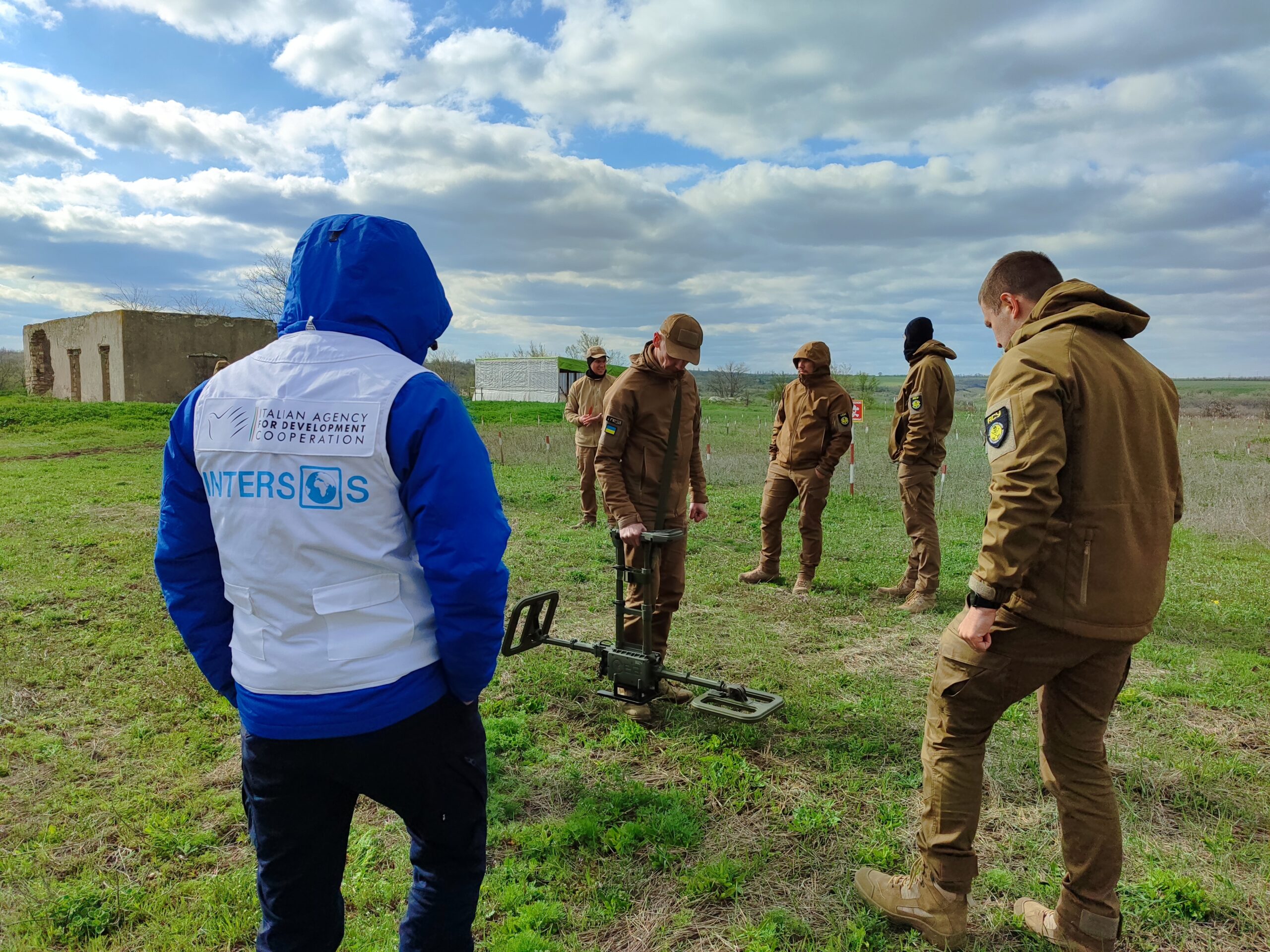
With the outbreak of the conflict in 2022, Ukraine has been hit by widespread contamination from landmines and explosive ordnance, making it one of the most heavily mined countries in the world today, with 22% of its territory potentially contaminated. As of 2024, mine action returns to the forefront of INTERSOS’s work: thanks to the support of Italian Cooperation (AICS) and collaboration with Ukrainian and international partners, a project has been launched aimed at reducing the risk of accidents caused by unexploded ordnance.
In Ukraine, the MAU is active in the regions of Kharkiv, Kherson, Mykolaiv, and Dnipro, among the areas most affected by the conflict and contamination from explosive ordnance. Mine Action activities in the field begin with the identification of contaminated zones. Through technical and non-technical surveys, the teams document areas at risk: the former involve the use of advanced metal detectors and geolocation technologies to precisely delineate contaminated zones; the latter, on the other hand, rely on the involvement of local communities and information gathered directly from those living in those territories.
Once identified, high-risk areas are mapped and marked with standard, clear, and easily recognizable signage. This step is essential to ensure that the population knows which areas to avoid and how to move around safely, especially those most at risk, such as farmers, children, internally displaced persons, and people with disabilities. For this reason, INTERSOS also conducts awareness-raising activities, both in person and online, to help communities recognize warning signs and adopt safe behaviors.