




In the last few years, millions of returnees have been pushed to return to Afghanistan from neighbouring countries. These Afghans have largely been returning with little or nothing after years or decades and now found themselves resourceless and in a country facing a challenging humanitarian and economic situation. INTERSOS has published an Advocacy Brief highlighting their situation, the organisation’s response, and calling international decision-makers to provide urgent and sustained support to ensure that Afghanistan’s returnees are not left behind.
After emerging from decades of conflicts in 2021, Afghanistan remains entrapped in a multi-layered crisis. Almost 22 million people, slightly less than half of Afghanistan’s population, are considered to be in need of humanitarian assistance in 2026, and more than 5 million Afghans have returned from neighbouring countries, mainly Iran and Pakistan, in the last 3 years.
INTERSOS, present in Afghanistan since 2001, currently manages projects across seven provinces, all of them delivering assistance to local communities, including returnees. This Advocacy Brief, developed thanks to interviews with returnees households, the broader experience of INTERSOS staff in assisting returnee families, as well as secondary information, aims to provide an overview of the current needs and challenges of returnees and share INTERSOS’ humanitarian response. Finally, it outlines key recommendations to respond to the ongoing crisis.
Returns to Afghanistan
In an already challenging socio-economic context, resulting in a devastating humanitarian impact for the majority of the Afghan population, the return of large numbers of Afghans from neighboring countries has added further strain to a fragile system with overstretched resources. In 2025, almost 3 million Afghans returned to Afghanistan.
The majority of returnees are forced to return to Afghanistan. People often recount how they were forced to leave their homes within hours. As a result, people often leave with only the most essential belongings and return to a country they, in many cases, have not been to for decades. This makes the return process extremely sudden and traumatic, particularly for households already facing severe economic hardship.
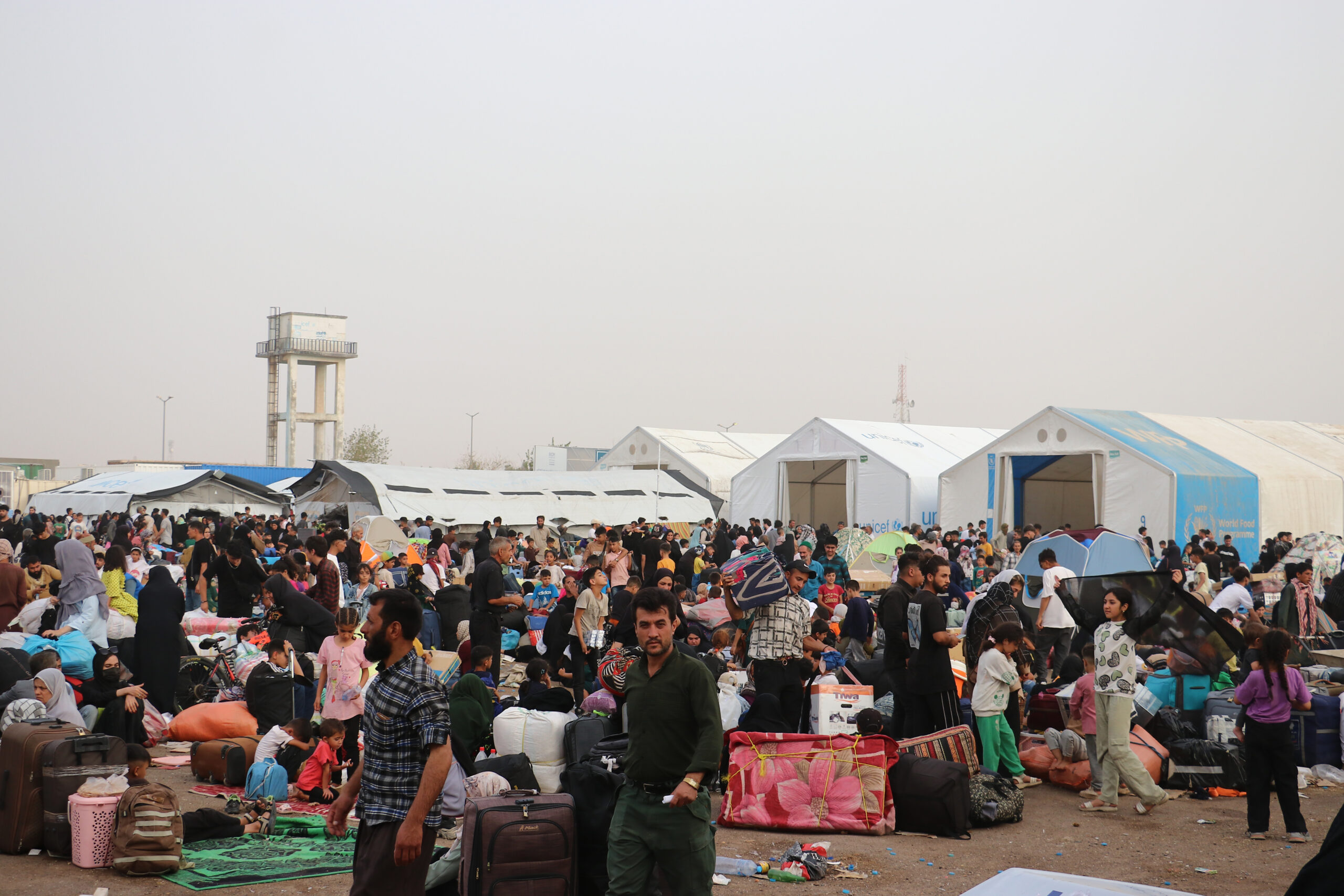
The reception center of the Islam Qala border crossing between Afghanistan and Iran. In July 2025 more than 585,000 Afghans returned to Afghanistan from Iran
Needs and challenges
Afghan returnees often arrive at the border exhausted, disoriented, and with very limited resources after long and difficult journeys carrying only a few belongings and little information about what awaits them inside Afghanistan. Immediate needs are acute and wide-ranging, including access to healthcare, food, safe water, shelter, and protection support, needs that are compounded by stress, trauma, and uncertainty about the future.
While some emergency assistance is available at major border crossings, this support is short-term and insufficient to address the scale and complexity of needs. Once returnees move beyond entry points, they face widespread poverty, limited services, and scarce livelihood and economic opportunities, making reintegration extremely difficult. For many families, the struggle to meet basic needs quickly turns into a prolonged fight for stability and dignity in a country already under immense humanitarian pressure.
INTERSOS intervention
INTERSOS mainly provides its assistance though basic health centers providing integrated health, nutrition, and protection support, while also supporting immunisation, kit distributions, cash distribution, and WASH activities. Some of these facilities are located in areas close to border points, areas known for the presence of high numbers of returnees, while others are located in local communities.
Initially, INTERSOS assistance to returnees was focused in Kandahar province, where INTERSOS has been present for years. In 2025, thanks to the support of the European Union, INTERSOS expanded its activities to other provinces, namely Nimruz, Herat, and, more lately, Helmand. In these areas we either work close to border points, such as in Zaranj in Nimruz province or Bharmacha in Helmand province, or in areas with relevant returnees’ settlements such as in the case of Herat, where INTEROS runs two health facilities in communities with a relevant returnee population.
At the same time, INTERSOS is also present in Kabul, Zabul, and Oruzgan, where, while still delivering assistance to local communities, we also support and assist returnees households, when present.
Recommendations
This brief calls for renewed and principled engagement from the international community, including increased humanitarian funding, targeted development assistance, and strengthened cross-border support. It also urges all states, especially neighbouring countries and European governments, to recognise that conditions in Afghanistan are not conducive for safe and dignified returns and that protecting Afghans, and supporting their ability to rebuild their lives, is both a humanitarian imperative and a shared responsibility.
Download the Advocacy Brief to consult the full list of recommendations.